Japanese Sauna Etiquette: Rules & Manners You Should Know Before Visiting
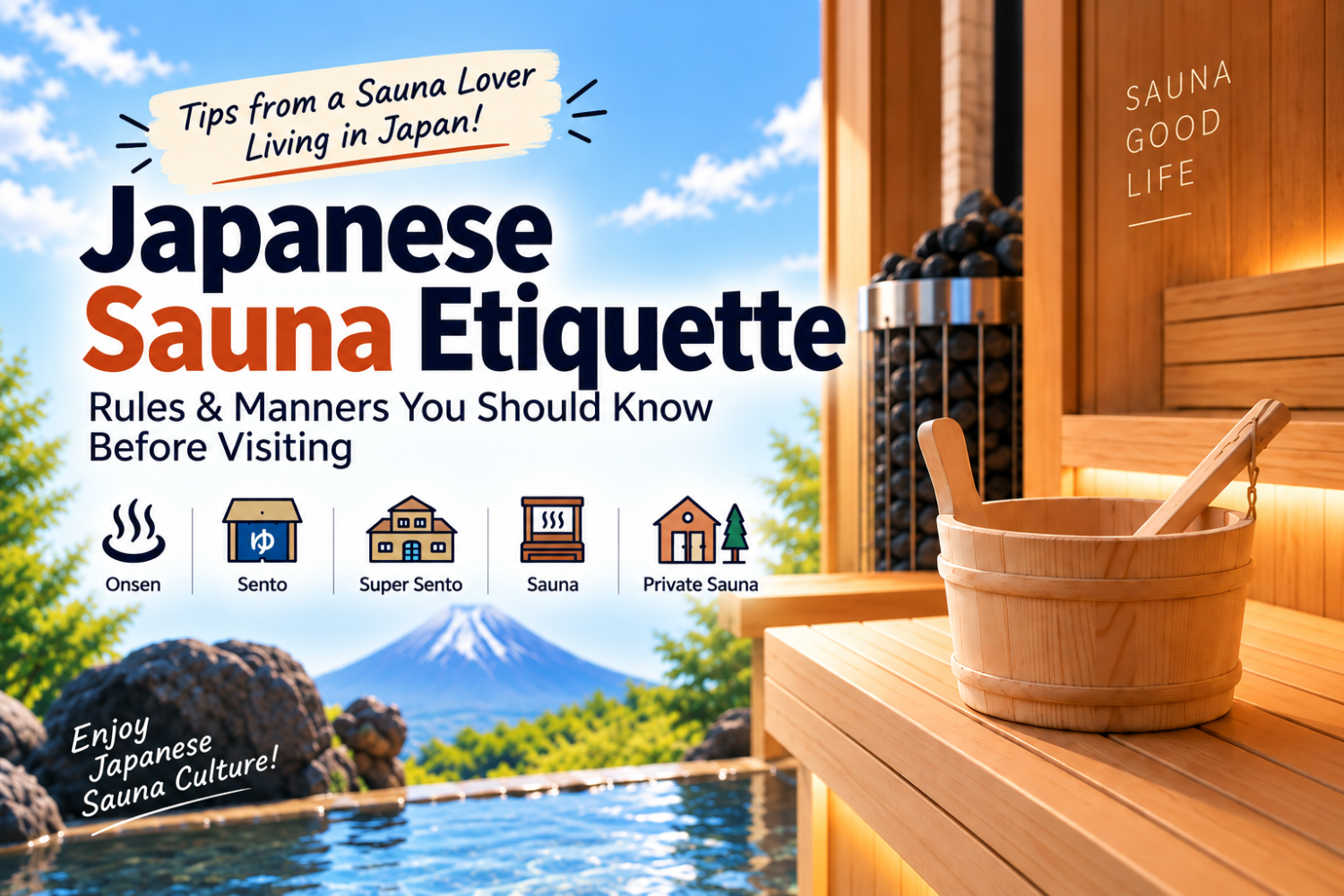
Are you planning a trip to Japan?
When you think of Japan, you may picture its many hot springs, or onsen. But Japan actually has many different types of bathing and sauna facilities, and they can be a little confusing if you’re visiting for the first time.
There are also some uniquely Japanese rules and unwritten manners that you should know before you go.
I’m a sauna and onsen lover living in Japan, and in this guide, I’ll explain Japanese sauna and bathing etiquette from a local’s perspective.
If you’re thinking about visiting an onsen or sauna during your trip to Japan, I hope this guide helps!
- Travelers who want to visit a sauna or onsen in Japan
- Anyone who wants to learn about Japanese sauna and bathing rules and etiquette
First, Understand Japanese Bathing Facilities
Japan has several different types of bathing and sauna facilities.
Let’s take a look at the main ones.
①Onsen
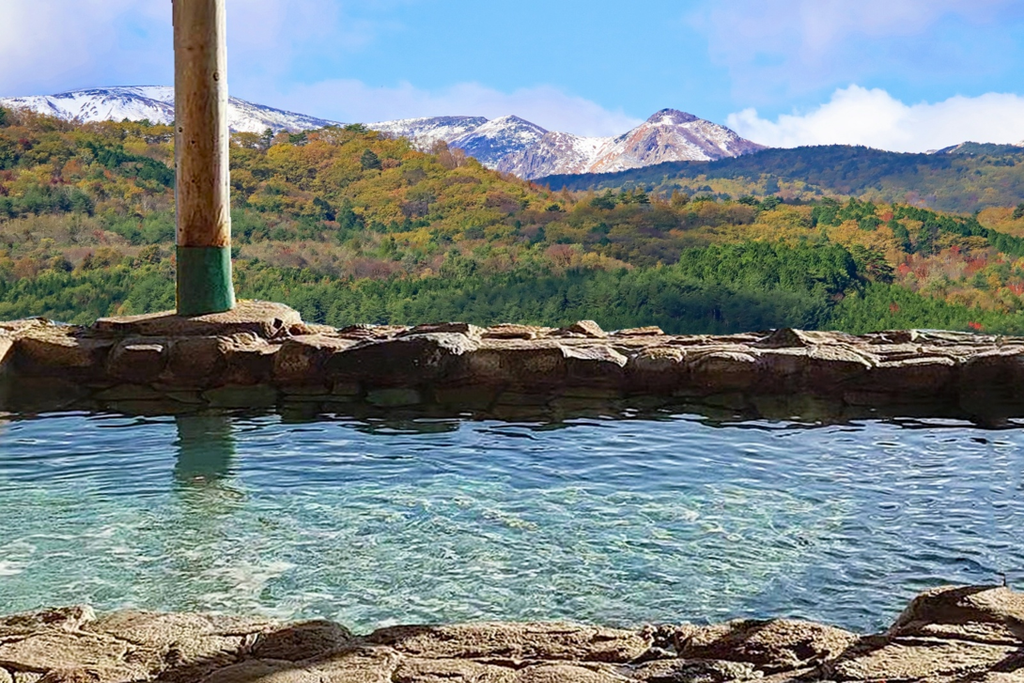
Onsen generally refers to natural hot springs.
Without getting too technical about the official definition, some of Japan’s most famous onsen destinations include Beppu in Oita Prefecture and Hakone in Kanagawa Prefecture.
There are two main ways to enjoy an onsen: large public baths shared with other guests, and private baths such as those found in rooms or available for private rental at traditional Japanese inns (Ryokan).
When people talk about visiting a hot spring while traveling in Japan, this is usually what they mean.
Best for: Experiencing traditional Japanese travel culture
②Sento
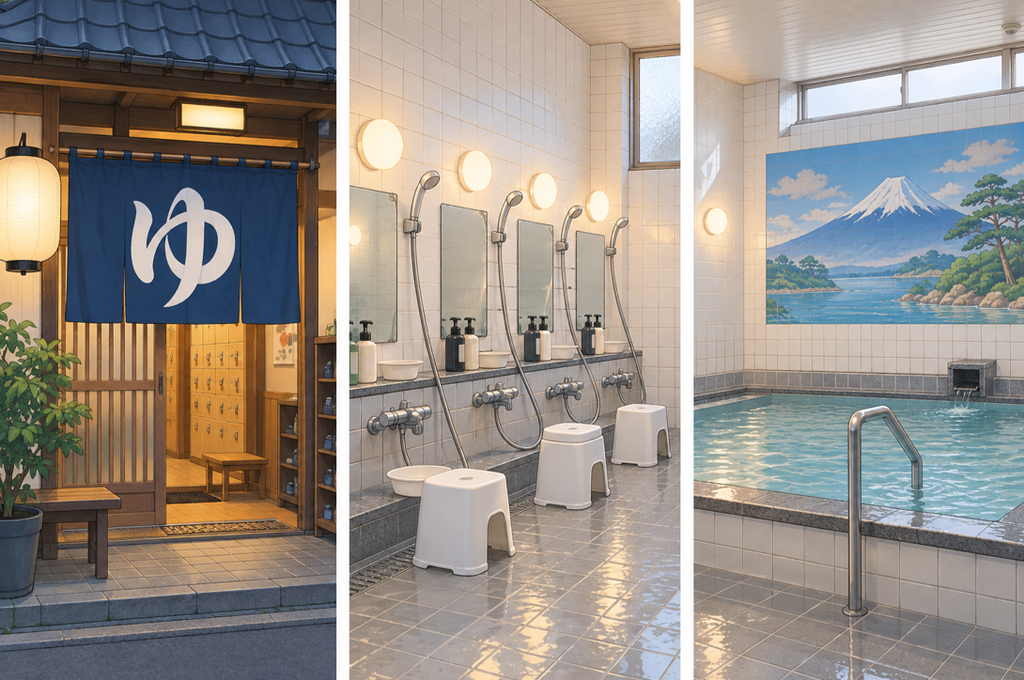
A Sento is a public bathhouse.
You’ll often find them in residential neighborhoods, where local people use them as part of everyday life. Admission is usually relatively inexpensive, often under ¥1,000.
Unlike many tourist-oriented facilities, sento are primarily designed for local residents. English support may therefore be limited.
However, if you’d like to experience a more local side of Japanese bathing culture, visiting a sento can be a very interesting experience.
Best for: Experiencing local Japanese culture
③Super Sento
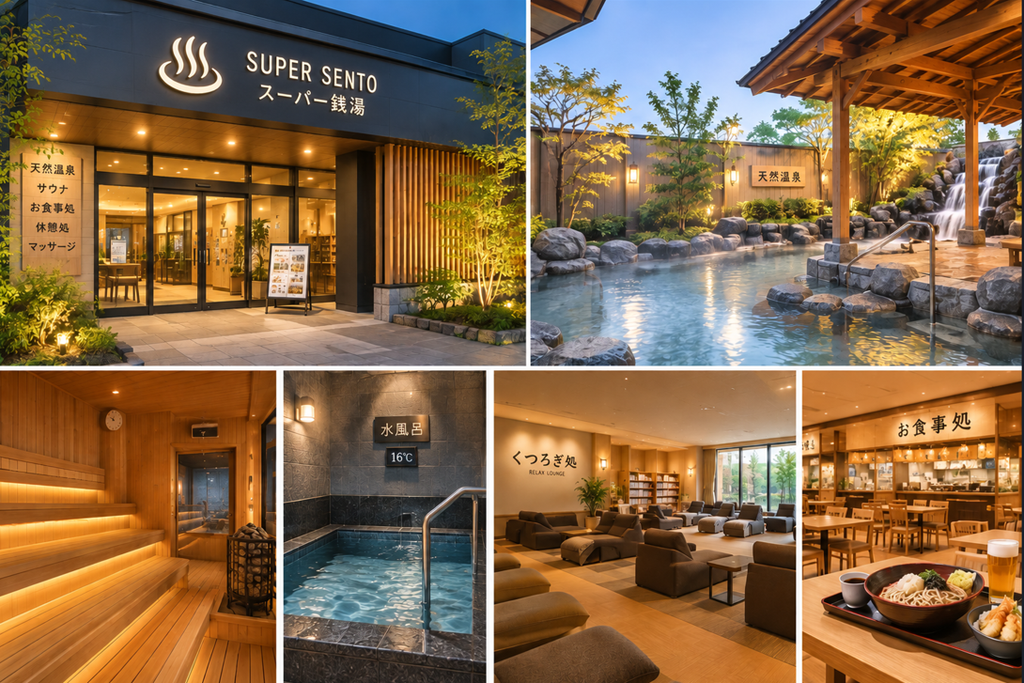
A Super Sento is a large bathing complex that brings together baths, saunas, restaurants, massage services, relaxation areas and other facilities under one roof.
They usually cost more than a traditional sento—often a few thousand yen—but you can enjoy many different types of baths, have a meal, relax, and sometimes even spend hours reading manga or books.
They’re extremely popular in Japan. I go to super sento quite often myself!
If there’s one near where you’re staying in Japan, it’s definitely worth considering.
Best for: People who want an almost theme-park-like Japanese bathing experience
④Sauna Facility
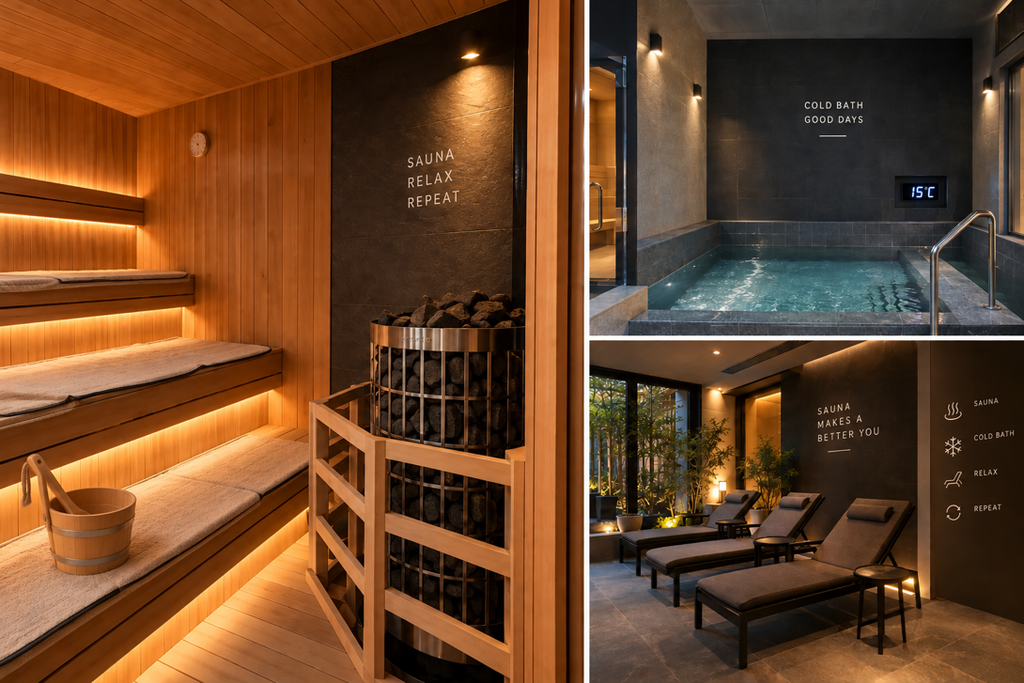
As the name suggests, a sauna facility is a place focused primarily on saunas.
Saunas have become very popular in Japan, so you’ll find dedicated sauna facilities in many parts of the country.
Compared with super sento, these facilities tend to have fewer additional amenities. A typical setup might simply consist of a sauna, cold bath and relaxation area.
If the sauna itself is the main reason for your visit, this is probably the type of facility you’re looking for.
Best for: Sauna lovers
⑤Private Sauna
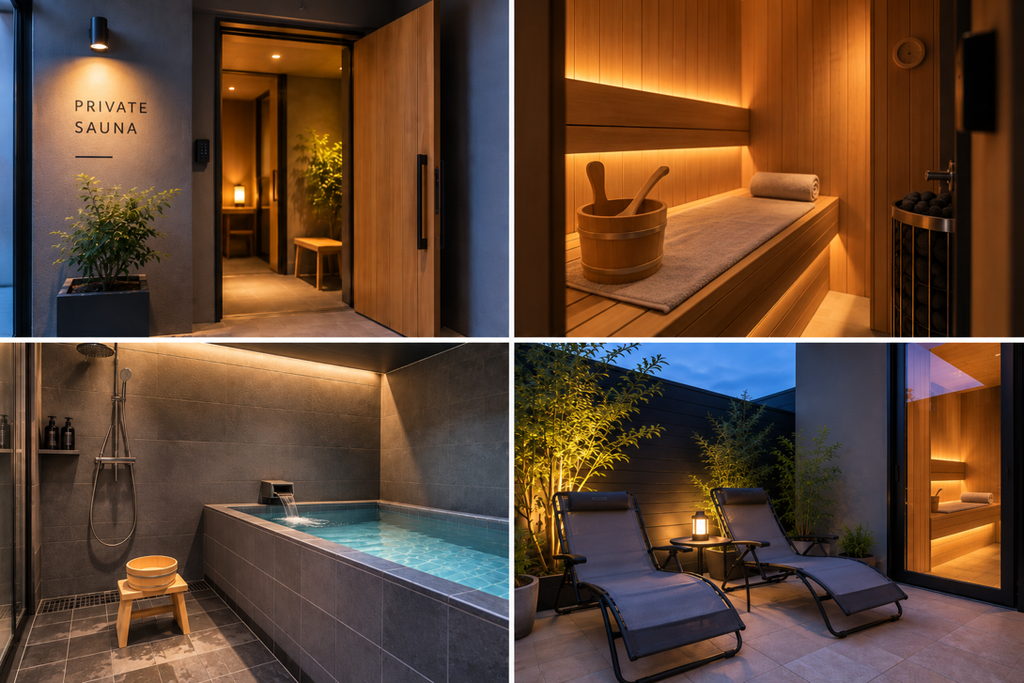
A private sauna is a type of sauna facility that gives you your own private room or, in some cases, lets you reserve the entire facility.
Unlike public saunas, you won’t be sharing the space with strangers.
You can relax alone without being disturbed, or enjoy the sauna with your family, friends or partner, depending on the facility’s rules.
Private saunas tend to be more expensive, but many are stylish, clean and comfortable.
Best for: Sauna lovers, especially couples, families and people who value privacy
Public Sauna vs. Private Sauna — What’s the Difference?
Now let’s compare public and private saunas.
| Public Sauna | Private Sauna | |
| Other guests | Yes | Usually only you and your group |
| Nudity | Usually nude | Depends on the facility; swimsuits may be required for mixed-gender use |
| Men & women | Usually separated | Some facilities allow mixed-gender groups |
| Etiquette | Important | Generally more relaxed |
| Cold bath | Shared | Often private |
| Löyly | Self-löyly may not be allowed | Self-löyly is often available |
| First-time visitors | May feel a little intimidating | Often easier and more private |
| Price | Relatively affordable | More expensive |
| Reservation | Usually not required | Often required |
| Time limit | Often none | Usually time-limited |
| Conversation | Quiet conversation or silence is generally expected | Usually more relaxed |
| Tattoos | Depends on the facility; restrictions are still common | Depends on the facility |
Put simply, Public saunas are relatively affordable and allow you to relax at your own pace, but you’ll be sharing the space with other people, so following proper etiquette is important.
Private saunas cost more, but you can enjoy the experience with only yourself or your companions around, making them a good option if you prefer privacy.
How to Use a Japanese Bath & Sauna — Step by Step
Here’s a step-by-step guide to using a Japanese bath or sauna.
Although facilities differ, the basic process and etiquette are generally similar. It’s a good idea to understand these steps before your visit.
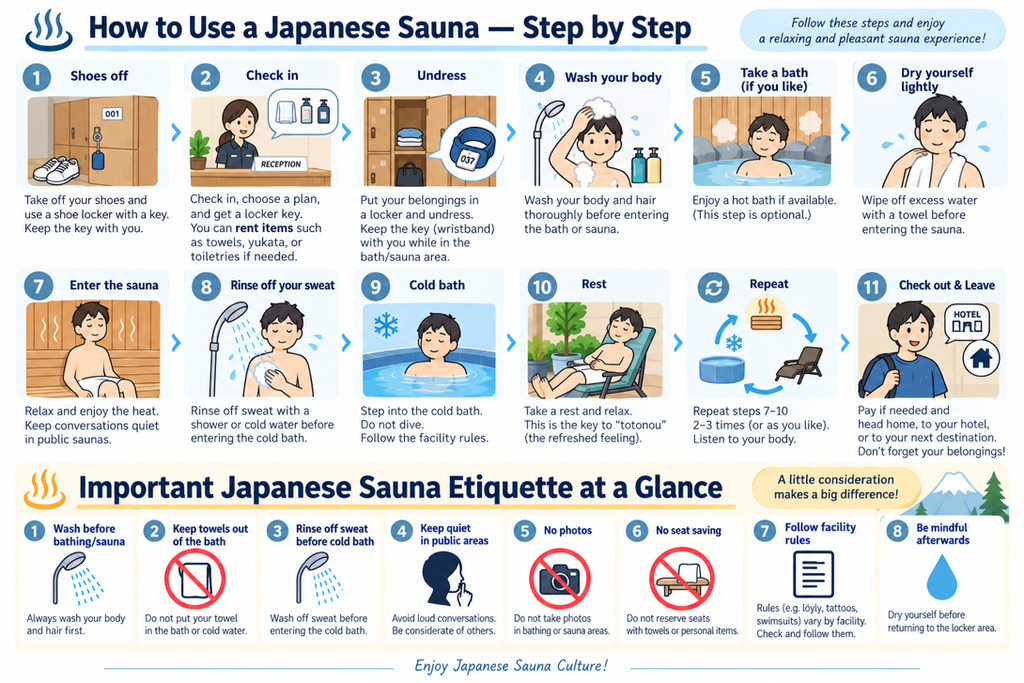
① Shoes off
Shoes are generally not allowed inside Japanese bathing facilities. Take off your shoes at the entrance and put them in a shoe locker.
Depending on the facility, you may keep the shoe-locker key with you or hand it to the front desk. Just follow the staff’s instructions.
② Check in
Head to the reception desk and check in. If there are different plans or time options, choose the one you prefer.
Some facilities also rent or sell useful items such as towels, toiletries or clothing, so get anything you need at this point.
At larger facilities such as super sento, you’ll often receive a numbered locker key or wristband.
Some facilities require payment when you enter, while others use a pay-later system.
③ Undress
If you’ve been given a numbered locker key, find the corresponding locker and put your clothes and belongings inside. If no locker has been assigned, you can usually choose an available one.
Lock it and take the key with you into the bathing and sauna areas. A waterproof wristband-style key is very common in Japan.
④ Wash your body
This is one of the most important parts of Japanese bathing etiquette.
Before entering a bath or sauna, wash your body thoroughly—and preferably your hair as well.
At onsen, super sento and sauna facilities commonly visited by travelers, shampoo, conditioner and body wash are often provided.
If they aren’t available, at the very least rinse sweat and dirt from your body with water before entering the bath or sauna.
⑤ Take a bath if you like
If you’d like to enjoy the bath before your sauna session, go ahead!
Some sauna-only facilities don’t have a regular hot bath, so this step is optional.
In Japan, you should not put your small towel into the bath or cold bath. You can place it on your head, leave it somewhere permitted near the bath, or hang it somewhere where it won’t touch the water.
It’s generally fine to bring a small towel into the sauna room.
⑥ Dry yourself lightly
Before entering the sauna, lightly dry your hair and body with a towel.
It is generally considered good manners to avoid entering the sauna soaking wet.
⑦ Enter the sauna
Now it’s sauna time!!
In public saunas, loud conversations are generally discouraged, and some facilities may ask guests not to talk at all.
Other guests may be meditating or simply enjoying some quiet time, so try to keep conversations to a minimum.
Whether self-löyly—pouring water onto the sauna stones yourself—is permitted depends entirely on the facility. Never assume it’s allowed. Check the rules first.
⑧ Rinse off your sweat
When you leave the sauna, rinse off your sweat before entering the cold bath. You can use a shower or pour water over yourself.
Entering the cold bath while still covered in sweat is considered poor manners in Japan.
⑨ Cold bath
Once you’ve rinsed off your sweat, you can enter the cold bath.
Some facilities don’t allow guests to submerge their heads or dive underwater, so always follow the facility’s rules.
⑩ Rest
After the cold bath, take a break in the relaxation area.
This is where you may experience what Japanese sauna fans call “totonou.”
Try to stay relatively quiet here as well. Other guests may be meditating, resting or even sleeping.
Japanese sauna fans often use the word “totonou” (ととのう) to describe the deeply relaxed feeling after alternating between the sauna, cold water and rest.
Repeat Steps ⑦–⑩ depending on how you feel, how much time you have and your personal preference. Many people enjoy around two or three rounds, but there’s no required number. Listen to your body and don’t push yourself.
Personally, I usually do four rounds!
⑪ Check out & Leave
Once you’ve finished enjoying the baths and sauna, it’s time to check out and head back to your hotel, home or next destination.
If the facility uses a pay-later system, you’ll pay your admission fee and any additional charges—such as food, drinks or massage services—at reception.
Some older facilities, including traditional sento, may only accept cash. For that reason, I recommend carrying at least ¥2,000–¥5,000 in cash, just in case.
Do You Have to Be Naked?
Depending on the customs in your home country, this may be one of the biggest surprises about Japanese bathing culture.
In most traditional Japanese public bathing facilities, yes—you’ll be naked.
At sento, super sento, public baths in onsen ryokan and many public sauna facilities, the bathing areas are usually completely separated by gender.
Once you enter the bathing area, people generally don’t wear swimsuits. In fact, wearing a swimsuit in a traditional Japanese public bath is usually not allowed.
However, mixed-gender bathing facilities, outdoor saunas and some private saunas may require swimsuits.
Check the facility’s rules in advance or ask the staff if you’re unsure.
Common Questions
・Can I wear a swimsuit?
→Usually not in traditional public baths.
・Can I wrap myself in a towel?
→Generally not while entering the bath.
・Are men and women separated?
→Usually, yes.
What About Tattoos?
For many international travelers, one of the biggest questions is:
Can I use a Japanese bath or sauna if I have tattoos?
Some bathing and sauna facilities in Japan still restrict entry for guests with tattoos. However, policies vary significantly from one facility to another.
You may find policies such as:
・Tattoo OK
・Cover stickers allowed
・Small tattoos only
・Tattoos not allowed
I strongly recommend checking the facility’s official rules before you visit.
Otherwise, you could arrive only to discover that you aren’t allowed to enter—which would be a terrible way to start your sauna experience!
In my sauna reviews, I include information about tattoo policies whenever possible, so feel free to check them when planning your visit.
What Should You Bring?
①Almost Essential
Small Towel
A small towel is useful for washing and drying yourself while you’re in the bathing area. Having one with you makes things much easier.
Cash
As mentioned above, some older facilities only accept cash. Even facilities that offer cashless payment may use payment methods that aren’t convenient for international visitors.
I recommend carrying around ¥2,000–¥5,000 in cash so you don’t run into payment problems.
②Useful
Bath Towel
You’ll use this to dry yourself before getting dressed.
Towel policies vary widely. Some facilities require you to bring your own, some rent them for a fee, some limit how many you can use, while others provide unlimited towels.
If you’re unsure, bringing one towel of your own is a safe option.
Change of Clothes
Bring fresh underwear or a change of clothes if you want.
Of course, there’s nothing wrong with simply putting the clothes you arrived in back on!
Toiletries & Cosmetics
Many modern facilities provide basic amenities, but what’s available varies.
If you need specific skincare products, shaving items, hair wax or other personal products, it’s best to bring your own.
Hair dryers are also commonly available. However, it also depends on each facility.
Drinks
Some facilities provide free drinking water, but I recommend making sure you have something to drink.
Many facilities have vending machines or drink counters inside, so you can also buy something there.
Many modern facilities provide, rent or sell almost everything you need, so it’s often possible to visit without bringing much at all.
Important Japanese Sauna Etiquette at a Glance
Before visiting a Japanese sauna, remember these basic rules:
- Wash your body before entering the bath or sauna.
- Never put your towel in the bath or cold bath.
- Rinse off your sweat before entering the cold bath.
- Keep quiet and be considerate of other guests.
- Do not take photos in bathing, changing or sauna areas.
- Do not reserve seats with towels or personal belongings.
- Follow each facility’s rules for löyly, tattoos, swimsuits, etc.
- Dry yourself before returning to the changing room.
If you remember these basic rules and respect the people around you, you’ll be able to enjoy Japanese sauna culture without worrying too much about etiquette.
Final Tips for First-Time Visitors
Japanese sauna and bathing etiquette may seem complicated at first, but don’t worry too much!
Be considerate of the people around you, wash yourself before entering the bath, rinse off your sweat before getting into the cold bath, and generally keep things quiet. If you remember those basics, you’ll be able to enjoy Japanese baths and saunas without much trouble.
So use this guide, relax, and enjoy Japanese sauna culture!
Enjoy your sauna experience in Japan!
Fin